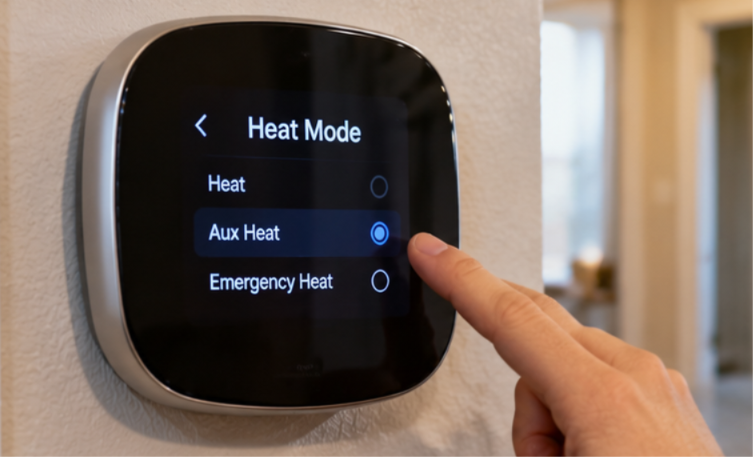
If your thermostat says AUX HEAT on a cold Dallas morning, your heat pump is getting help from its backup heat, and that’s usually normal. EM HEAT is different. It’s a setting you turn on yourself, and it shuts the heat pump off so only the backup heat runs.
That’s the core of emergency heat vs. aux heat. Aux heat comes and goes on its own whenever the heat pump needs a hand, while emergency heat is a manual switch for when the outdoor unit can’t run. Mixing the two up can mean a higher electric bill, or a broken heat pump that goes unnoticed.
Dallas winters bring mild days, chilly nights, and the odd hard freeze. A heat pump in good shape handles most of that on its own and only needs backup heat for short stretches.
How Does a Heat Pump Heat Your Dallas Home?
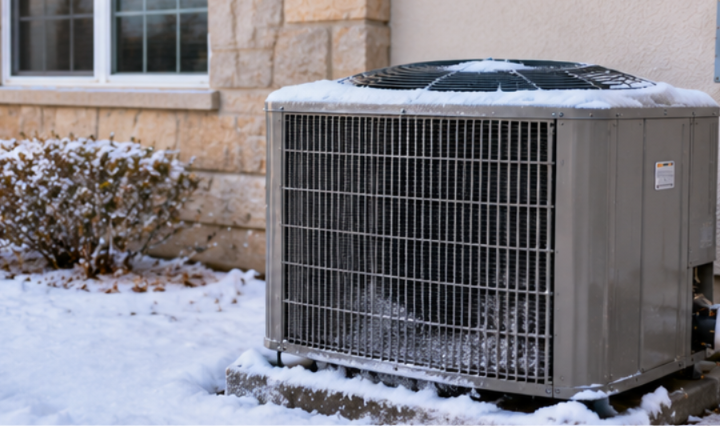
An air-source heat pump doesn’t burn fuel to make heat. It pulls heat out of the outdoor air, even on a cold day, and moves it indoors, then runs in reverse to cool your home in summer. When your heat pump system can’t keep up on its own, its backup heat steps in, and that backup is what AUX HEAT and EM HEAT both control.
What Is Auxiliary Heat on a Heat Pump?
Auxiliary heat, commonly displayed as AUX HEAT on a thermostat, is a supplemental heating stage that helps your heat pump maintain the indoor temperature. It usually activates automatically when the thermostat determines that the heat pump needs additional heating capacity. You generally do not need to switch it on yourself.
Many residential heat pumps use electric resistance heat strips inside the indoor air handler as their auxiliary heat source. Some systems use a dual-fuel arrangement, where a gas furnace provides additional heat under specific operating conditions. The exact operation depends on the equipment, thermostat settings, and system configuration.
When auxiliary heat activates, the heat pump may continue running alongside the backup source. In certain dual-fuel systems, the controls may switch from the heat pump to the furnace instead. Either way, the purpose is to help your home reach or maintain the desired temperature when the primary heating operation needs assistance.
When Does Auxiliary Heat Turn On?
Your thermostat and heat pump controls determine when supplemental heat is needed. Common situations include:
- Cold outdoor temperatures: The heat pump may have less heating capacity as outdoor temperatures fall, depending on its model and operating range.
- A large thermostat adjustment: Raising the temperature several degrees at once can create a demand that triggers additional heating.
- Defrost operation: During certain winter conditions, the outdoor coil can develop frost. The system may use supplemental heat to help maintain indoor comfort while it defrosts.
- High heating demand: Poor insulation, air leakage, or unusually cold weather can make it harder for the heat pump to maintain the set temperature.
Seeing AUX HEAT occasionally does not automatically mean your system is malfunctioning. It is a normal part of many heat pump systems. However, if auxiliary heat runs for unusually long periods during relatively mild Dallas weather, a professional inspection can help determine whether the system has an airflow, thermostat, refrigerant, or equipment issue.
What Is Emergency Heat on a Heat Pump?
Emergency heat is a manually selected thermostat mode designed for situations when the heat pump should not be used to provide heating. When you select this setting, many conventional systems disable the outdoor heat pump operation and rely on the backup heating source instead.
For example, if your heat pump develops a mechanical problem and cannot operate safely or effectively, emergency heat may allow the indoor backup system to provide temporary warmth. If your equipment uses electric heat strips, those elements supply the heat. In a dual-fuel system, the backup furnace may take over, depending on how the system is designed.
Emergency heat is not a stronger version of auxiliary heat. Aux heat helps a working heat pump on its own, while emergency heat bypasses the heat pump and runs the backup by itself. It isn’t a money saver, and it isn’t a setting for a freezing night. With a working heat pump, leave the thermostat on Heat and let aux heat do its job.
When Should You Use Emergency Heat?
Emergency heat is meant for an equipment problem, or for when a technician tells you to use it. Common situations include:
- The outdoor unit has stopped operating and the home is losing heat.
- The heat pump has a confirmed mechanical or electrical failure.
- A technician has advised temporarily bypassing the heat pump.
- The outdoor unit has visible damage that makes continued operation questionable.
If you suspect a problem, contact an HVAC professional rather than repeatedly changing thermostat modes or attempting repairs yourself. Emergency heat can help maintain indoor comfort in some situations, but it does not fix the underlying problem. Treat it as a temporary measure until the system can be properly inspected.
Emergency Heat vs. Aux Heat: What Is the Difference?
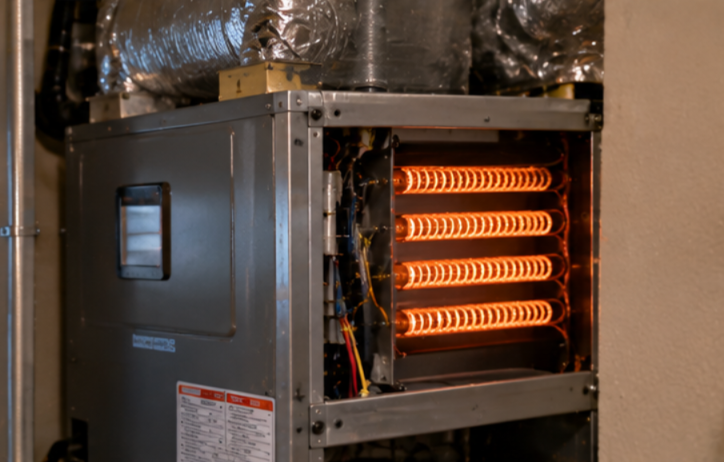
Aux heat and emergency heat use the same backup heat, but they do different jobs. Aux heat helps a working heat pump, and emergency heat stands in for a heat pump that can’t run.
| Comparison | Auxiliary Heat (AUX) | Emergency Heat (EM HEAT) |
|---|---|---|
| How it activates | Usually turns on automatically | Selected manually at the thermostat |
| Main purpose | Supplements heating when the heat pump needs help | Provides backup heating when the heat pump should not operate |
| Heat pump operation | Often operates with the heat pump, depending on system design | Typically disables the heat pump compressor |
| Backup heat source | Often electric heat strips or a configured secondary system | Usually the same backup source used for auxiliary heating |
| When it is appropriate | Cold conditions, defrost, or increased heating demand | A heat pump problem or technician recommendation |
| Homeowner action | Usually no action is needed when operation is normal | Use only when appropriate and arrange professional service |
| Cost to run | Higher than the heat pump alone while it runs | Usually the highest, because only the backup heat runs |
Not every heat pump uses the same backup arrangement. Electric resistance systems and dual-fuel systems can operate differently. Your equipment documentation and thermostat configuration determine exactly how the two modes work.
Does Auxiliary Heat Cost More to Run?
In many systems, yes. Aux heat raises your electricity use when it relies on electric heat strips, the most common backup in all-electric homes.
Heat strips turn each unit of electricity into one unit of heat. A heat pump moves heat in from outside, so in mild weather it delivers several units of heat for the same electricity. That gap is why a few hours of heat strips shows up on the bill when a few hours of heat pump doesn’t.
How much more depends on the outdoor temperature, your electricity rate, your home’s insulation, and how long the backup heat runs. A short aux heat cycle on a cold morning costs little, while heat strips that run for hours every day add up fast.
How often the strips run comes down to your heat pump’s balance point and its aux heat settings, the same numbers that decide whether a Dallas home needs a cold-climate heat pump. A technician can add an outdoor temperature lockout when setting up a smart or programmable thermostat, so the strips stay off on mild days, even when someone raises the setting.
If your energy bills increase unexpectedly, do not assume the thermostat is the only problem. Dirty filters, restricted airflow, refrigerant issues, incorrect thermostat settings, or equipment faults can all affect heating performance. A professional diagnostic can identify why the system is relying on backup heat.
When Is AUX HEAT on a Heat Pump a Sign of a Problem?
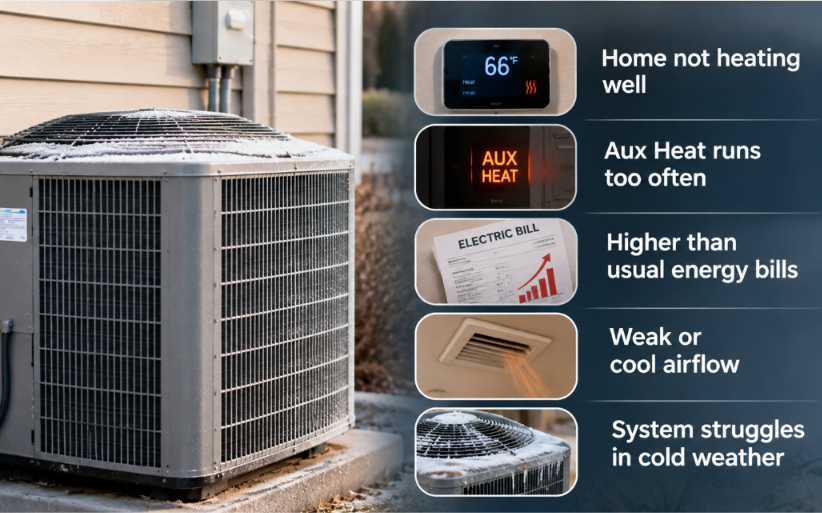
AUX HEAT points to a problem when it runs for long stretches on mild days, or when the outdoor unit isn’t doing its share. Short bursts on a cold morning are normal.
5 Warning Signs Worth Monitoring When Your Heat Pump Runs on Aux Heat
1. AUX HEAT stays on during mild weather. If supplemental heating runs often when the weather is mild, the heat pump may not be delivering the heat it should. It isn’t an emergency, but book a visit before the next cold snap.
2. EM HEAT is on and nobody set it. Emergency heat only turns on when someone selects it, so check whether a family member or a bumped thermostat switched it. Left on by mistake, it runs only the backup heat and raises your bill fast, so set it back to Heat and watch whether the outdoor unit starts.
3. Your electricity bills increase unexpectedly. Frequent operation of electric heat strips can raise energy consumption. A sudden change in heating costs deserves investigation, especially if your household habits have not changed.
4. AUX HEAT is on, but the outdoor unit isn’t running. When the backup heat is carrying the whole house, the heat pump outside may have stopped. Look for a fan that doesn’t turn or a unit that stays silent, and schedule a repair soon, because the strips keep running up the bill until it’s fixed.
5. Ice stays on the outdoor unit after a defrost cycle. A light frost that melts off every so often is normal in a Dallas winter. A thick block of ice that doesn’t clear means the heat pump can’t heat properly, and it needs a technician to find out why.
These signs do not identify a specific failed component by themselves. They are reasons to have the system evaluated rather than repeatedly switching between heating modes.
What Should You Do When Your Thermostat Displays AUX HEAT or EM HEAT?
If AUX HEAT shows up for a short while as your home warms up on a cold day, leave the thermostat on Heat and let the system manage its heating stages. That’s normal supplemental heat. If it stays on for hours, or EM HEAT is on, work through the checks that fit your situation.
What to Check When AUX HEAT Stays On for Hours
- Check that the air filter is clean, since a clogged filter cuts the airflow a heat pump depends on.
- Make sure furniture, rugs, and curtains aren’t blocking supply vents or return grilles.
- Confirm the thermostat is set to Heat, not EM HEAT.
- Raise the temperature a degree or two at a time instead of several at once, because a big jump calls for backup heat.
- If AUX HEAT still runs for hours on a mild day, book a heat pump repair visit.
What to Do When EM HEAT Is On or the Heat Pump Stops Running
- Check whether someone switched the thermostat to EM HEAT by mistake. If the outdoor unit runs normally, set it back to Heat.
- From a few feet away, look at the outdoor unit. Is it running, is it buried in ice that doesn’t clear, or is anything bent or broken?
- Don’t open electrical panels or try to repair the outdoor unit yourself.
- Leave EM HEAT on only to keep the house warm until a technician can look at it, and call (469) 921-1136 for emergency heating service.
How Can Proactive Air Conditioning Help When Your Heat Pump Keeps Using Backup Heat?
When a heat pump relies on backup heating more often than expected, the most useful next step is finding out why. Replacing equipment or assuming the heat strips are defective without testing the system can lead to unnecessary expenses. A proper diagnosis should consider airflow, refrigerant performance, thermostat controls, electrical components, and the heat pump’s overall heating operation.
Proactive Air Conditioning brings 15+ years of Dallas HVAC experience and EPA 608 Universal certified technicians to every heating call. Our technicians check the whole system before they tell you anything, then give you options, from the minimum repair that gets it running to the fix that heads off the next breakdown. You choose, with no pressure to replace a system that can be repaired.
If your heat pump is struggling to keep your home warm, our heat pump repair technicians can find out why, often the same day when the schedule allows. If it’s running fine but you want it checked before the next cold snap, heat pump maintenance covers airflow, electrical components, refrigerant, thermostat operation, and the defrost cycle. Call Proactive Air Conditioning at (469) 921-1136 or book a visit for your Dallas home.
Frequently Asked Questions
1. Is it normal for AUX HEAT to come on during a Dallas winter?
Yes, AUX HEAT coming on during a Dallas winter is normal. It switches on when outdoor temperatures fall, when the thermostat recovers from a big setback, or when the heat pump runs a defrost cycle. Frequent or long runs during mild weather deserve a technician’s look.
2. Should I turn on Emergency Heat when it gets very cold outside?
Turning on Emergency Heat when it gets very cold outside isn’t necessary. Your heat pump keeps heating in cold weather, and the thermostat brings on aux heat when it needs more capacity. Emergency Heat is for a heat pump that’s broken, or for when a technician tells you to bypass it.
3. Is Emergency Heat more expensive than Auxiliary Heat?
Emergency Heat can cost more to operate because it typically relies entirely on the backup heating source instead of using the heat pump. If that source is electric resistance heat, it generally consumes more electricity per unit of heat delivered than an efficiently operating heat pump. Your own cost depends on your system and your electricity rate.
4. Is it a problem if AUX HEAT stays on all day?
AUX HEAT staying on all day is usually a sign of a problem, unless it’s one of the coldest days of the year. Aux heat is meant to help in short stretches, and running it for hours, especially with electric heat strips, raises your bill. If the AUX indicator stays on for much of the day in mild weather, have the system inspected.
5. Can emergency heat stay on overnight?
Emergency heat can stay on overnight if your heat pump is broken and you’re waiting for a repair visit. It’s built to carry the house for a while, but it costs more than normal heating because only the backup heat is working. Once a technician has fixed the heat pump, switch the thermostat back to Heat.